
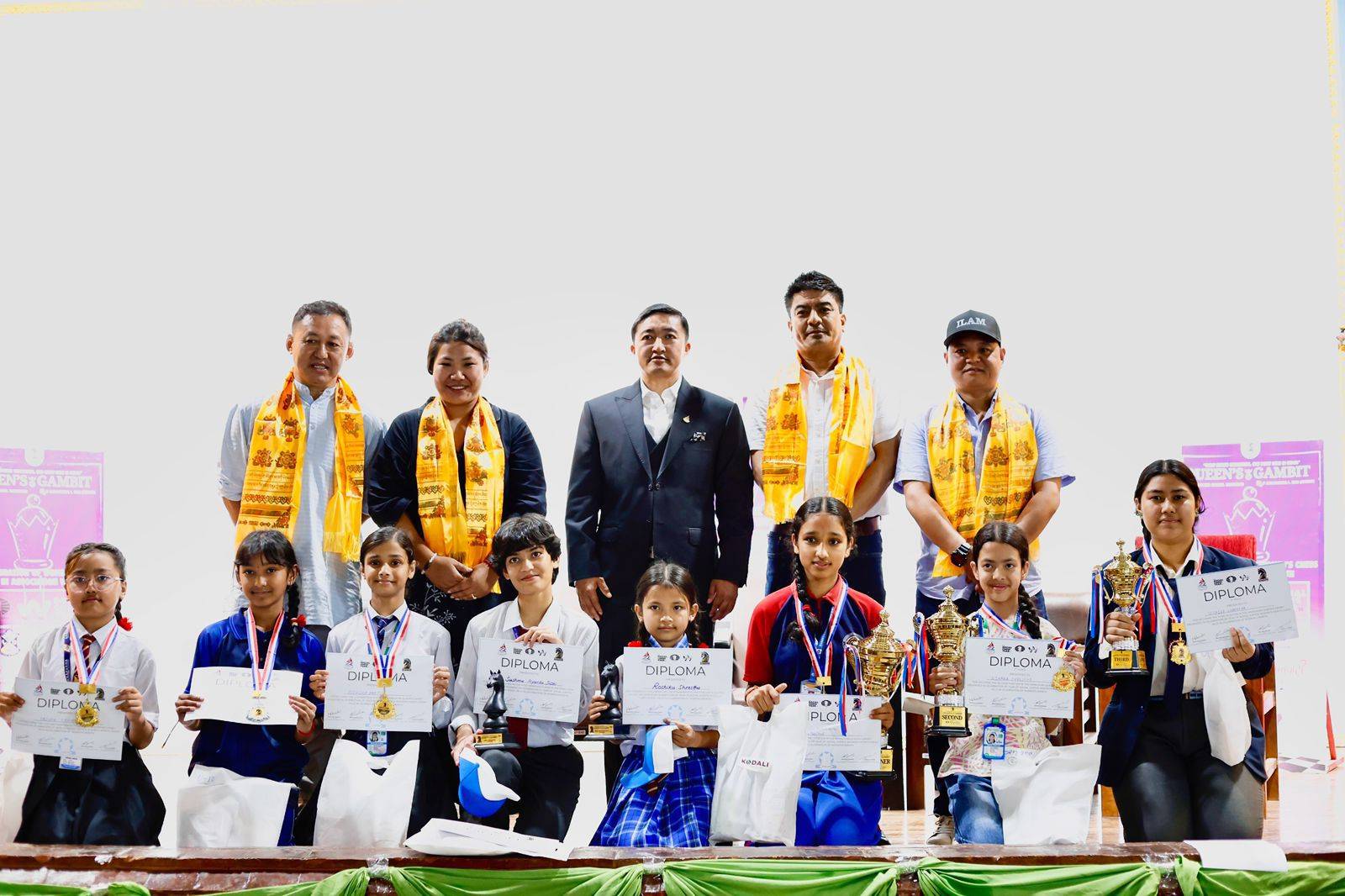
Himalayan Queen's Gambit 2025
Kathmandu, August 17, 2025 — On a single Sunday in August, 142 women and girls walked into the chess hall at St. Xavier's College, Maitighar, and made history. The Himalayan Queen's Gambit, organised by the Himalayan Chess Academy (HCA) as part of FIDE's Women's Chess Marathon, became the largest women's and girls' chess tournament ever held in Nepal — and one of the most significant days in the country's chess story.
The players ranged in age from 5 to 67. They came from schools, universities, government offices, media organisations, and communities across Kathmandu. Many were playing in a formal chess event for the very first time. By the end of the day, a 14-year-old from Manakamana Secondary School had won the title — and Nepal had earned recognition from FIDE as a landmark chapter in a global movement.
Part of Something Bigger
The Queen's Gambit did not happen in isolation. It was one of eight flagship events of the FIDE Women's Chess Marathon, a worldwide initiative run by the FIDE Commission for Women's Chess (WOM) as part of FIDE's designation of 2025 as its Social Year. That August, tournaments took place simultaneously across Africa (South Africa and Zambia), the Americas (Puerto Rico and Venezuela), Europe (Portugal and Italy), and Asia-Oceania (Nepal and Australia). Of those eight events, the Himalayan Queen's Gambit was the only one held anywhere in Asia.
The initiative was led by Monalisha Khamboo — HCA Founder, Nepal's first Women's National Chess Champion, International Arbiter, and a member of the FIDE Commission for Women's Chess — who has been at the centre of efforts to grow women's participation in Nepalese chess since the academy's founding in 2024. The Queen's Gambit was, in many ways, the fullest expression yet of that work: an open invitation to women and girls of any background, any age, and any experience level to come, play, and belong.
A Record That Tells Its Own Story
The 142 participants shattered Nepal's previous record for female chess participation. The prior benchmark had been set at the Himalayan Teej Tournament in 2024 — with 37 players. The Queen's Gambit multiplied that number nearly fourfold. The field was deliberately unrated, designed not as a high-performance selection event but as a welcoming entry point — a tournament where a girl playing her second-ever competitive game could sit at the same table as a woman in her forties who had discovered chess through a workplace community.
The depth of participation reflected the breadth of the outreach. Institutions represented in the starting list included schools such as Manakamana Secondary, Marvellous Boarding School, Pathshala Nepal Foundation, Matribhumi School, and Rato Bangala School; colleges including St. Xavier's College itself; and a range of organisations from Voices of Women Media and Women in Cyber Security to the Department of Roads, Himalaya Airlines, and the Armed Police Force. Chess, for one day at least, brought all of them to the same 64 squares.
The Champion: Precious Adhikari
Precious Adhikari, 14, of Manakamana Secondary School, emerged as champion with a perfect score of 7 points across the day's seven rounds — four of rapid chess and three of blitz, all played under the Swiss system. She defeated all 141 other competitors to claim the title without dropping a single point.
The race for the podium behind her was defined by a single moment: Nihana Shrestha of Himalayan Chess Academy went through the entire tournament unbeaten — but a draw in the second round cost her the title. She finished runner-up on 6.5 points, the half-point gap a reminder of how finely balanced the competition was at the top. Reshika Shrestha of Mahendra Secondary School completed the podium in third place with 6 points. Swastika Chaudhary, Dhanmantri Thapa, Meghna Adhikari, Sanskriti Gajurel, and Suhani Singh rounded out the top eight.
Age Categories: A Tournament for Every Generation
One of the defining features of the Queen's Gambit was its age-category structure, which ensured that players at every stage of life had their own separate recognition — from the youngest rising talents to the most experienced competitors.
In the Under-10 category, Anisha Tamang took first place, with Ananya Rauniyar second and Ritika Sedhai third. The Under-13 category was won by Vipasana Shakya, ahead of Nayuma Magar and Rijila Rajbhandari. In Under-16, Sonalika Shah topped the section, with Yashaswi Maharjan second and Aarohi Shrestha third. At the other end of the age spectrum, Rukmani Jimi — at 67, the oldest participant in the tournament — claimed the S-50+ (Veterans) title, a moment that drew particular appreciation from everyone present.
In the schools section, Manakamana Secondary School finished first, followed by Marvellous English Boarding School in second and Mahendra Secondary School in third.
An Opening Move to Remember
The tournament was inaugurated in the most fitting way possible. Palisha Govardhan — Nepal's historic bronze medallist at the Paris Paralympics 2024 — made the ceremonial first move on the chessboard, joined by film director Dipendra Lama and St. Xavier's College Principal Augustin Thomas. The presence of a Paralympic medallist at the opening was a deliberate signal: that the Queen's Gambit was about more than chess. It was about what becomes possible when institutions invest in women and girls.
Prizes, trophies, medals, and certificates were presented by Tanka Lal Ghising (Member-Secretary, National Sports Council), Dinesh Maharjan (Ward Chair, Kathmandu Metropolitan City-4), Dipen Rai (Senior Vice President, Nepal Chess Federation), Surendra Kumar Rai (President, Koshi Province Chess Association), Gehendra Bahadur Chand (Vice Principal, St. Xavier's College), and Monalisha Khamboo herself.
What Came After
The Queen's Gambit's impact did not end when the last game was played. In November 2025, Australian Grandmaster David Smerdon came to Kathmandu and played a 1-vs-10 simultaneous exhibition against a group of Aghori Baba chess players — a remarkable cultural encounter that traced its roots directly to the August tournament. A young female member of the Aghori community had participated in the Queen's Gambit, accompanied by members of her group. Through that connection, the wider community's love of chess — which the Aghoris play regularly in their kutis for mental discipline — became known to HCA. Six of the ten players in the November simultaneous were women, including a 10-year-old girl. The FIDE Commission for Women's Chess noted the episode as a striking example of how a women-led chess moment can grow into something no one could have anticipated.
The Queen's Gambit also fed directly into HCA's ongoing work with the Junkiri Feminist Library, where selected participants from marginalised communities were subsequently invited to join HCA events — using the tournament as an entry point into a longer journey with the game.
Nepal on the Global Map
FIDE's Commission for Women's Chess described the Himalayan Queen's Gambit as a historic success and warmly congratulated HCA, Monalisha Khamboo, and all players, partners, and supporters. FIDE's own reporting called the event a landmark that set a new benchmark for women's chess in Nepal, reflecting the full spirit of the Women's Chess Marathon: inclusivity, opportunity, and the celebration of women's potential through chess.
For HCA, the number 142 is the beginning of something, not the ceiling. For Nepal's women and girls in chess, the Queen's Gambit was a glimpse of what is possible when the door is simply left open.
Official tournament data: Chess-Results — Himalayan Queen's Gambit 2025. FIDE WOM coverage: wom.fide.com.